
Duat: Last Voyage of the Pharos is in development, with a target launch in early 2027.
Duat: Last Voyage of the Pharos is a psychological horror storytelling game for one to four players. A session takes 60 to 90 minutes. The core idea is in the tagline: you don’t follow the story, you uncover it.
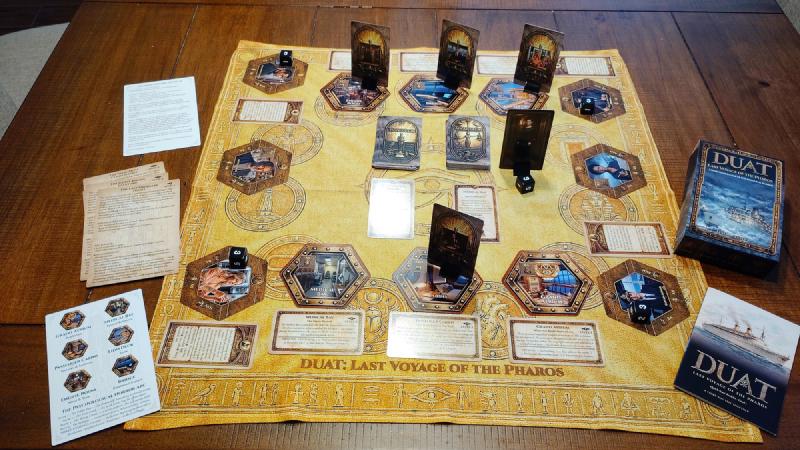
The premise#
The MS Pharos, a luxury liner bound for Alexandria, has vanished somewhere in the Mediterranean. You play Akhu, spirits who have passed through the Duat, the Egyptian underworld. You drift unseen through the ship’s corridors, its grand atrium, its medical bay, its bridge, and its engine room, piecing together what happened to the passengers. The horror isn’t in what happens next. It’s in what was already true.
Egyptian cosmology is the engine, not the decoration#
Many games use ancient Egypt as a backdrop. In Duat, it is how the game works. The Egyptian understanding of the soul (Ab, Ba, Akh, Ka, Ren) and the forces of Ma’at (order and truth) and Isfet (chaos and falsehood) shape how truth, identity, and memory behave at the table.
The Khaibit: the shadow every passenger hides#
Good psychological horror shows the sinister side of even the most trustworthy person. In Duat, that hidden side is the Khaibit, the shadow self. Every passenger on the Pharos carries one: the darkest secret they want to keep hidden, even from themselves.
Passengers begin the voyage with a carefully kept face. In Egyptian thought, the Ba is a person’s personality, the self they show the world. When the ship enters the Duat, that face begins to crumble. The Ab, the heart that holds a person’s conscience and truth, can no longer be hidden, since in Egyptian belief it is weighed against the feather of Ma’at. What each passenger truly is begins to surface. You don’t invent these secrets. You discover them, as the fog reveals one passenger’s Khaibit after another.
The ship’s six principal locations act as tests, each putting a psychological question to the story you’re building.
CALENA makes storytelling easy#
You don’t need to be a writer, an actor, or an experienced game master to play. Duat runs on the CALENA framework, which I’ve tested in workshops, online games, storytelling conferences, and gaming events. It turns the blank page into a few simple choices. Cards supply characters, situations, places, and secrets, and one player narrates a scene while the others build on it. No one controls the whole story, and no one has to perform character voices. Plain narration is enough.
The game then answers back. In Level 2, the ship itself reacts. Passengers move, secrets surface, and a mysterious Stowaway walks the corridors. Events add psychological twists for the players to untangle. A solo booklet, Solitary Passage, brings the same experience to a single player.
What you walk away with#
Every session ends with a complete story record. As Bram Stoker Award winner Angela Yuriko Smith describes it, “What unfolds is not just a game session, but a complete story record that is intimate, eerie, and personal each time.”
For writers and fellow storytellers#
Duat is designed to grow through collaboration, and while it is still in development, now is a good time to get involved. I’m gathering contributor stories for online showcase events and for inclusion in the printed game, with full credit to each author. Poet David Hershhorn recently joined the project, drawn by a shared interest in Egyptian culture and the unsettling nature of horror. If you write horror, work with Egyptian cosmology, or love building stories around a table, I’d like to hear from you.
Status: in progress, targeting an early 2027 launch. Ages 14+.